

Visual Analytics for Process Monitoring From Time Series to Interpretable Visual Representations
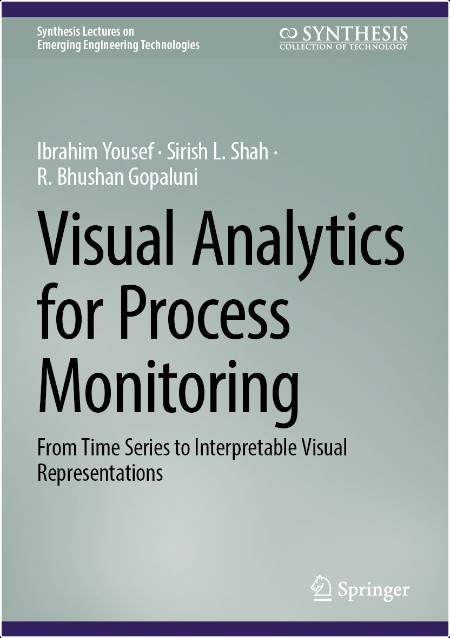
Visual Analytics for Process Monitoring From Time Series to Interpretable Visual Representations | 27.13 MB
Title: Visual Analytics for Process Monitoring From Time Series to Interpretable Visual Representations
Author: Ibrahim Yousef, Sirish L. Shah, R. Bhushan Gopaluni
Language: English | 86 Pages | ISBN: 3032221250
Description:
In the era of big data, process industries face the challenge of analyzing massive and complex data to extract information for effective process monitoring. This book introduces a novel paradigm called visual analytics. Visual analytics transforms chronological process data into visual formats to uncover patterns. This paradigm allows process experts to relate visual patterns to operational conditions and, consequently, support informed decision-making.
The book explores three pathways within the visual analytics paradigm: (i) feature engineering, in which predefined mappings are used to convert time series data into visual representations; (ii) architecture engineering, which develops neural network architectures to directly learn visual representations; and (iii) data engineering, which employs contrastive learning to highlight differences and similarities in the data without relying on annotations.
DOWNLOAD:
https://rapidgator.net/file/a802115f342175470521b79cf2805146/978-3-032-22126-1.rar
https://nitroflare.com/view/64C7F6319E7450F/978-3-032-22126-1.rar
In the era of big data, process industries face the challenge of analyzing massive and complex data to extract information for effective process monitoring. This book introduces a novel paradigm called visual analytics. Visual analytics transforms chronological process data into visual formats to uncover patterns. This paradigm allows process experts to relate visual patterns to operational conditions and, consequently, support informed decision-making.
The book explores three pathways within the visual analytics paradigm: (i) feature engineering, in which predefined mappings are used to convert time series data into visual representations; (ii) architecture engineering, which develops neural network architectures to directly learn visual representations; and (iii) data engineering, which employs contrastive learning to highlight differences and similarities in the data without relying on annotations.
DOWNLOAD:
https://rapidgator.net/file/a802115f342175470521b79cf2805146/978-3-032-22126-1.rar
https://nitroflare.com/view/64C7F6319E7450F/978-3-032-22126-1.rar

Information
Users of Guests are not allowed to comment this publication.

