

Deep Learning Innovations in MRI Reconstruction and Analysis
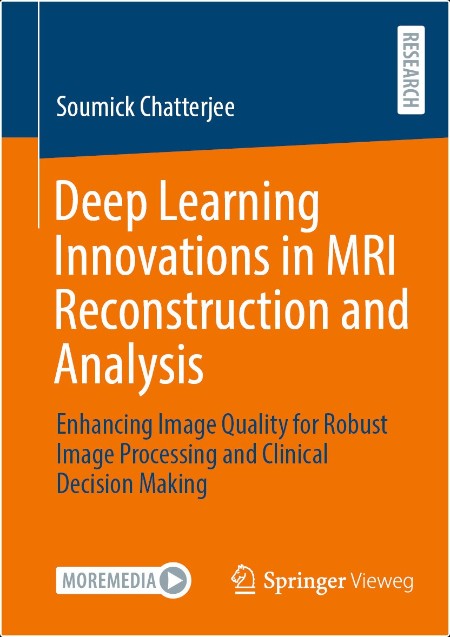
Deep Learning Innovations in MRI Reconstruction and Analysis | 99.1 MB
Title: Deep Learning Innovations in MRI Reconstruction and Analysis
Author: Soumick Chatterjee
Category: Nonfiction, Computers, Database Management, Data Processing, Science & Nature, Technology, Engineering
Language: English | 461 Pages | ISBN: 3658507403
Description:
High-resolution magnetic resonance imaging (MRI) is clinically vital but inherently slow. Accelerating acquisition via undersampling introduces artefacts, whereas long scans risk motion blur; traditional solutions, such as compressed sensing, often fail under such heavy corruption. Consequently, this thesis investigates deep learning methods to correct these artefacts. It develops pipelines for the reconstruction of undersampled (Cartesian and radial) and motion-corrupted data, and for super-resolution, whilst exploring the integration of prior knowledge and complex-valued convolutions. Beyond visual diagnostics, the thesis examines the impact of reconstruction on automated image processing. It proposes and evaluates pipelines for classification, segmentation (supervised and weakly/semi-supervised), anomaly detection, and registration. Validated on brain tumour and vessel tasks, the study demonstrates that the proposed deep learning-based reconstruction effectively supports both clinical inspection and robust automated decision-making systems.
DOWNLOAD:
https://rapidgator.net/file/71bd3a63b75cd582d33c7c681143bcbb/978-3-658-50741-1.rar
https://nitroflare.com/view/F4F21DB3B648493/978-3-658-50741-1.rar
High-resolution magnetic resonance imaging (MRI) is clinically vital but inherently slow. Accelerating acquisition via undersampling introduces artefacts, whereas long scans risk motion blur; traditional solutions, such as compressed sensing, often fail under such heavy corruption. Consequently, this thesis investigates deep learning methods to correct these artefacts. It develops pipelines for the reconstruction of undersampled (Cartesian and radial) and motion-corrupted data, and for super-resolution, whilst exploring the integration of prior knowledge and complex-valued convolutions. Beyond visual diagnostics, the thesis examines the impact of reconstruction on automated image processing. It proposes and evaluates pipelines for classification, segmentation (supervised and weakly/semi-supervised), anomaly detection, and registration. Validated on brain tumour and vessel tasks, the study demonstrates that the proposed deep learning-based reconstruction effectively supports both clinical inspection and robust automated decision-making systems.
DOWNLOAD:
https://rapidgator.net/file/71bd3a63b75cd582d33c7c681143bcbb/978-3-658-50741-1.rar
https://nitroflare.com/view/F4F21DB3B648493/978-3-658-50741-1.rar

Information
Users of Guests are not allowed to comment this publication.

