

Populations of Individuals Understanding Biological Variation From Molecules to Ecosystems
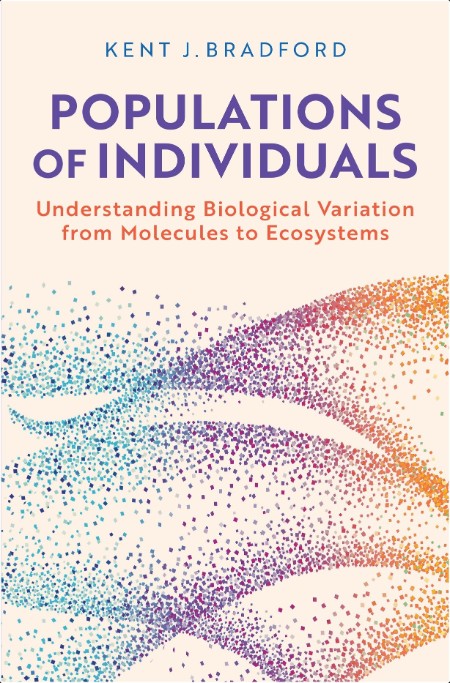
Populations of Individuals Understanding Biological Variation From Molecules to Ecosystems | 10.91 MB
Title: Populations of Individuals Understanding Biological Variation From Molecules to Ecosystems
Author: Kent J. Bradford
Category: Nonfiction, Science & Nature, Science, Biological Sciences, Genetics, Biology
Language: English | 249 Pages | ISBN: 9780197846018
Description:
Variation is an inherent component of biology, essential to selection among alternatives during evolution. It is most often associated with genetic variation, or differences among the genes encoded in the DNA inherited from ancestors. Individual organisms receive their genomes from a clonal parent or from the union of gametes. All subsequent cells, tissues, and organs developed from a clone or sexual union carry the same genome, but they exhibit the ability to develop into the diversity of cell types present in the organism. Such variation is influenced by both developmental and environmental factors, often referred to as being due to 'instability' or 'noise.' This book argues that the degree to which individual organisms adapt to this 'noise' is dependent on their sensitivities to these developmental or environmental factors. Focusing on their sensitivity thresholds enables the individuals to be grouped into populations that automatically respond to signal inputs. These sensitivity thresholds tend to vary among individuals in a normal distribution, such that as the factor level increases, more of the individuals are recruited to respond as their thresholds are exceeded. In addition, the amount by which the factor level increases above the threshold determines the speed of the response. The author, Kent Bradford, terms this method of grouping populations the 'population-based threshold' (PBT) model. Populations of Individuals illustrates with examples from each level of biological complexity that this underlying principle can replace instability and noise with a coherent and mathematically consistent description of stable variation observed across the breadth of biology. This viewpoint and model are particularly relevant today, when methods for investigating individual molecules, nuclei, organelles, and cells are available. The PBT model indicates that viewing such variation as being due to multiple subpopulations based on their threshold sensitivities is both simpler and more consistent with the available data.
DOWNLOAD:
https://rapidgator.net/file/bd3859b82eb39603c22a809ca629efb5/Populations_of_Individuals_-_Kent_J._Bradford.rar
https://nitroflare.com/view/A4A4AF9FE5C864A/Populations_of_Individuals_-_Kent_J._Bradford.rar
Variation is an inherent component of biology, essential to selection among alternatives during evolution. It is most often associated with genetic variation, or differences among the genes encoded in the DNA inherited from ancestors. Individual organisms receive their genomes from a clonal parent or from the union of gametes. All subsequent cells, tissues, and organs developed from a clone or sexual union carry the same genome, but they exhibit the ability to develop into the diversity of cell types present in the organism. Such variation is influenced by both developmental and environmental factors, often referred to as being due to 'instability' or 'noise.' This book argues that the degree to which individual organisms adapt to this 'noise' is dependent on their sensitivities to these developmental or environmental factors. Focusing on their sensitivity thresholds enables the individuals to be grouped into populations that automatically respond to signal inputs. These sensitivity thresholds tend to vary among individuals in a normal distribution, such that as the factor level increases, more of the individuals are recruited to respond as their thresholds are exceeded. In addition, the amount by which the factor level increases above the threshold determines the speed of the response. The author, Kent Bradford, terms this method of grouping populations the 'population-based threshold' (PBT) model. Populations of Individuals illustrates with examples from each level of biological complexity that this underlying principle can replace instability and noise with a coherent and mathematically consistent description of stable variation observed across the breadth of biology. This viewpoint and model are particularly relevant today, when methods for investigating individual molecules, nuclei, organelles, and cells are available. The PBT model indicates that viewing such variation as being due to multiple subpopulations based on their threshold sensitivities is both simpler and more consistent with the available data.
DOWNLOAD:
https://rapidgator.net/file/bd3859b82eb39603c22a809ca629efb5/Populations_of_Individuals_-_Kent_J._Bradford.rar
https://nitroflare.com/view/A4A4AF9FE5C864A/Populations_of_Individuals_-_Kent_J._Bradford.rar

Information
Users of Guests are not allowed to comment this publication.

