

Composites Materials for Food Packaging by David Bekaert
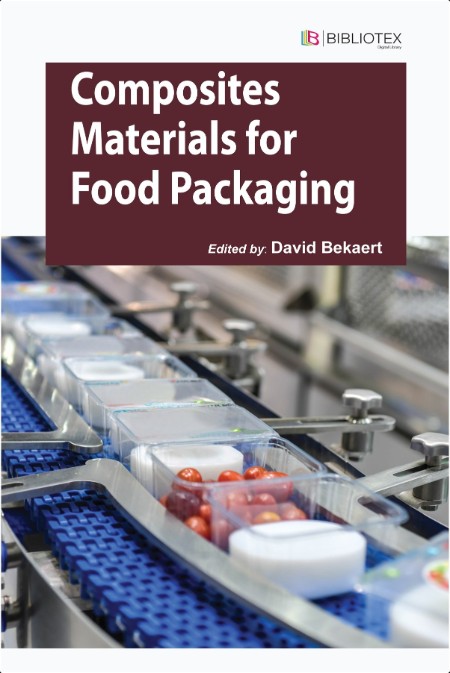
Composites Materials for Food Packaging by David Bekaert | 22.95 MB
Title: David Copperfield Student'S Pack (With CD+Glossary)
Author: Charles Dickens
Language: English | 294 Pages | ISBN: 9789605731458
Description:
Nowadays, there are dominant scientific breakthroughs to advance the packaging industry to identify innovative and emerging fruitful results for making the food packaging systems, in particular, more efficient, resilient, and sustainable. Therefore, friendliness packaging research has been gaining momentum, thanks to global environmental awareness, and also consumer ecological consciousness, and leading companies are committing to a more holistic worldview of packaging in response to more sustainable processes to reduce pollution and any depletion of resources. Biobased polymers are of great interest due to the release of tension on non-renewable petroleum-based polymers for environmental concerns. However, biobased polymers usually have poor mechanical and barrier properties when used as the main component of coatings and films, but they can be improved by adding nanoscale reinforcing agents (nanoparticles - NPs or fillers), thus forming nanocomposites. The nano-sized components have a larger surface area that favors the filler-matrix interactions and the resulting material yield. For example, natural fibers from renewable plants could be used to improve the mechanical strength of the biobased composites. In addition to the mechanical properties, the optical, thermal and barrier properties are mainly effective on the selection of type or the ratio of biobased components. Biobased nanocomposites are one of the best alternatives to conventional polymer composites due to their low density, transparency, better surface properties and biodegradability, even with low filler contents. In addition, these biomaterials are also incorporated into composite films as nano-sized bio-fillers for the reinforcement or as carriers of some bioactive compounds. Therefore, nanostructures may provide antimicrobial properties, oxygen scavenging ability, enzyme immobilization or act as a temperature or oxygen sensor. The promising result of biobased functional polymer nanocomposites is shelf life extension of foods, and continuous improvements will face the future challenges.
The book is intended as an overview on the recent and more relevant developments in the application of composite materials for food packaging applications. This book will also focus on materials used in nanocomposite polymers with their functional properties for food packaging applications. Moreover, it provides an overview of the performance of bioplastics and their limitations. State-of-the-art main trends on green biocomposites thereof, their potential to transform the food industry, are also herein considered. Packaging materials play a pivotal role in the worldwide market and global food packaging sales are expected to reach $411.В billion by 2025. Commonly-employed materials consist of fossil-derived polymers, the use of which has led to dramatic environmental and ecological concerns, as they are not biodegradable. For these reasons, biopolymers have attracted a lot of interest and have been investigated, even if their industrial application is prevented by their poor mechanical, thermal and barrier properties. Thus, there is an urgent need for the formulation and development of innovative and multifunctional systems based on biopolymers and natural and synthetic additives, both inorganic (e.g., calcium phosphates (CaP), silica, calcium carbonate, nanoclays, etc.) and organic, in order to provide improved performance, in terms of mechanical reinforcement, and antioxidant and antimicrobial features for potential applications in the food packaging sector. These state-of-the-art packaging technologies, when combined with innovations in food product design, will create a plethora of new groundbreaking opportunities for the food industry.
DOWNLOAD:
https://rapidgator.net/file/9c9ecd735e849427be525d85a4475aea/Composites_Materials_for_Food_Packaging_by_David_Bekaert.rar
https://nitroflare.com/view/570345C87B62261/Composites_Materials_for_Food_Packaging_by_David_Bekaert.rar
Nowadays, there are dominant scientific breakthroughs to advance the packaging industry to identify innovative and emerging fruitful results for making the food packaging systems, in particular, more efficient, resilient, and sustainable. Therefore, friendliness packaging research has been gaining momentum, thanks to global environmental awareness, and also consumer ecological consciousness, and leading companies are committing to a more holistic worldview of packaging in response to more sustainable processes to reduce pollution and any depletion of resources. Biobased polymers are of great interest due to the release of tension on non-renewable petroleum-based polymers for environmental concerns. However, biobased polymers usually have poor mechanical and barrier properties when used as the main component of coatings and films, but they can be improved by adding nanoscale reinforcing agents (nanoparticles - NPs or fillers), thus forming nanocomposites. The nano-sized components have a larger surface area that favors the filler-matrix interactions and the resulting material yield. For example, natural fibers from renewable plants could be used to improve the mechanical strength of the biobased composites. In addition to the mechanical properties, the optical, thermal and barrier properties are mainly effective on the selection of type or the ratio of biobased components. Biobased nanocomposites are one of the best alternatives to conventional polymer composites due to their low density, transparency, better surface properties and biodegradability, even with low filler contents. In addition, these biomaterials are also incorporated into composite films as nano-sized bio-fillers for the reinforcement or as carriers of some bioactive compounds. Therefore, nanostructures may provide antimicrobial properties, oxygen scavenging ability, enzyme immobilization or act as a temperature or oxygen sensor. The promising result of biobased functional polymer nanocomposites is shelf life extension of foods, and continuous improvements will face the future challenges.
The book is intended as an overview on the recent and more relevant developments in the application of composite materials for food packaging applications. This book will also focus on materials used in nanocomposite polymers with their functional properties for food packaging applications. Moreover, it provides an overview of the performance of bioplastics and their limitations. State-of-the-art main trends on green biocomposites thereof, their potential to transform the food industry, are also herein considered. Packaging materials play a pivotal role in the worldwide market and global food packaging sales are expected to reach $411.В billion by 2025. Commonly-employed materials consist of fossil-derived polymers, the use of which has led to dramatic environmental and ecological concerns, as they are not biodegradable. For these reasons, biopolymers have attracted a lot of interest and have been investigated, even if their industrial application is prevented by their poor mechanical, thermal and barrier properties. Thus, there is an urgent need for the formulation and development of innovative and multifunctional systems based on biopolymers and natural and synthetic additives, both inorganic (e.g., calcium phosphates (CaP), silica, calcium carbonate, nanoclays, etc.) and organic, in order to provide improved performance, in terms of mechanical reinforcement, and antioxidant and antimicrobial features for potential applications in the food packaging sector. These state-of-the-art packaging technologies, when combined with innovations in food product design, will create a plethora of new groundbreaking opportunities for the food industry.
DOWNLOAD:
https://rapidgator.net/file/9c9ecd735e849427be525d85a4475aea/Composites_Materials_for_Food_Packaging_by_David_Bekaert.rar
https://nitroflare.com/view/570345C87B62261/Composites_Materials_for_Food_Packaging_by_David_Bekaert.rar

Information
Users of Guests are not allowed to comment this publication.

